
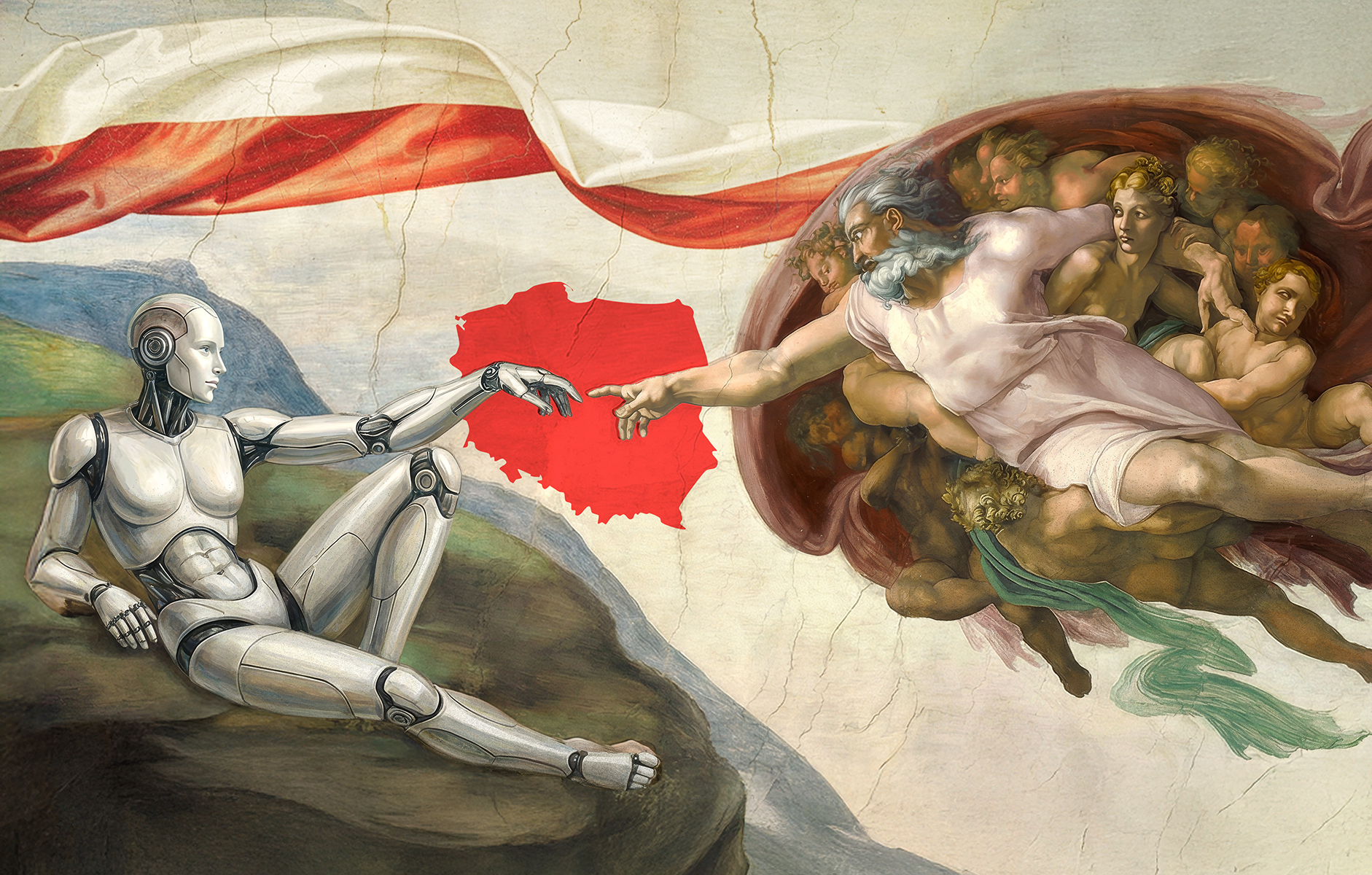
When the world marvels at breakthroughs in artificial intelligence, the spotlight almost always points toward Silicon Valley. What’s less known is that, buried deep inside these systems, at the architectural and algorithmic level, lies a remarkable concentration of Polish ingenuity.
Inside OpenAI, the research lab behind the GPT series, you will find Polish names threaded through almost every major technical milestone. They appeared at the founding table, shaped the early engineering culture, and now lead the development of systems that many believe could define the next era of computing.
What follows is the story of how a country of 38 million quietly became one of the world’s most influential powerhouses in artificial intelligence — and why that influence is still growing.
Table of Contents
A Quiet Powerhouse Behind the World’s Most Advanced AI
The modern AI ecosystem is not short on myths: lone geniuses, overnight breakthroughs, machines suddenly “waking up.” But the real story of technological progress is always more grounded — it lives in research labs, talent pipelines, and communities of people who spend years refining their mathematics long before the rest of the world notices.
That is precisely what happened with Poland.
As the global AI race accelerated, Poland’s contribution didn’t come with loud announcements or national campaigns. Instead, it emerged in the résumés of the world’s top labs, in the authorship of breakthrough papers, and in the performance metrics of models redefining what computers can do.
Ask insiders at OpenAI, and they’ll tell you the same thing: when a frontier research problem gets impossibly hard, it often ends up in the hands of a Polish engineer.
The Polish “AI Mafia”: How a University Became a Global Launchpad
In global tech circles, the phrase “Polish AI Mafia” is uttered half jokingly, half with reverence.
It refers to the unusually dense concentration of Polish researchers working on frontier systems — many of whom passed through the same academic institution: the University of Warsaw.
If this sounds improbable, consider the numbers:
- The University of Warsaw is a dominant force in the International Collegiate Programming Contest, consistently placing among the global elite.
- It is the only university in the world with three alumni in leadership roles at the most valuable AI lab on the planet.
- Alumni from its mathematics and computer-science programs populate some of the most advanced AI teams worldwide.
What makes this pipeline so formidable is not size, but depth. Polish technical education emphasizes algorithmic problem-solving, mathematical purity and competitive programming — the exact skill set required to design, train, and debug the world’s most complex AI systems.
This is less a “mafia” and more a high-performance engine that the rest of the world hasn’t fully recognized yet.
Inside OpenAI: The Polish Architects of the Frontier
Inside the San Francisco headquarters of OpenAI, Poland’s fingerprints are everywhere.
A Founder at the Table
One of the most influential figures is Wojciech Zaremba, one of the original 11 founders alongside Sam Altman, Elon Musk, Greg Brockman, and Ilya Sutskever.
Zaremba shaped OpenAI’s robotics and reinforcement-learning programs, both foundational to what came later: models capable not just of generating text, but of solving problems through reasoning.
A First-50 Talent Surge
In the early days, approximately 10 of the first 50 employees were Polish — an astonishing ratio for a Silicon Valley research lab hiring globally.
Sam Altman once put it bluntly:

“OpenAI hasn’t met a problem they [the Polish team] can’t solve.”
Polish Leadership Today
Fast-forward to 2026, Polish researchers now hold some of the lab’s most critical technical roles, including Chief Scientist and Head of Post-Training — roles that define how frontier models reason, align with human values, and interface with the real world.
Breakthroughs That Changed the Field: From GPT-4 to the o1 Reasoning Revolution
While GPT-4 captured public imagination, insiders quietly point to the o1 model family as a deeper breakthrough — a step toward systems capable of deliberate, multi-step reasoning.
And once again, Poles were at the center.
The o1 Research Group
Of the seven researchers leading o1’s development, five are Polish. This may turn out to be one of the most significant Polish contributions to global science in the 21st century.
A Medical Benchmark That Turned Heads
Under Polish leadership, the o1 model achieved 93.3% accuracy on the Polish National Medical Exam (LEK), surpassing many licensed physicians and setting a new benchmark for clinical-reasoning AI.
The Language Surprise
In a twist that surprised even OpenAI researchers:
Polish is the #1 top-performing language for long-context, complex reasoning tasks
— with 88% accuracy, beating English, Chinese, and other high-resource languages.
The language that shaped the mathematicians is now the language where the machines perform best.
Why Poland Produces Elite AI Talent
Poland’s consistent outperformance in AI is not an accident. It stems from three structural advantages:
-
A Deep Mathematical Tradition
From Banach and Ulam to modern combinatorics and probability theory, Poland’s mathematical culture runs unusually deep. AI rewards exactly this kind of abstraction and rigor.
-
A National Obsession with Competitive Programming
Polish students don’t just learn to code — they train to solve algorithmic puzzles under extreme pressure. Many of today’s top AI engineers began as Olympiad medalists.
-
High Adoption Across Industry
Poland is among Europe’s leaders in AI adoption, creating a rare combination: elite academic talent and plenty of real-world environments to deploy advanced systems.
-
The EU’s #1 AI Talent Pool
Poland ranks #1 in the EU for AI and Data Science talent availability — ahead of France, Germany, and the Nordics.
The result is a small country punching far above its weight in a technology that will define the next century.
How Adanto Leverages Poland’s Talent Engine
For companies building agentic systems, large-scale data platforms, or enterprise AI infrastructure, access to frontier-level talent is no longer a luxury — it is a competitive moat.
Adanto’s presence in Poland gives us direct access to the same ecosystem that produces researchers at OpenAI, Google DeepMind, and other global AI leaders.
This proximity is strategic: it allows Adanto to build systems grounded in mathematical robustness, efficient architectures, and the kind of reasoning models that define the frontier.
In a field evolving as fast as AI, geography still matters — especially when geography dictates talent density.
Conclusion
From founding members of the world’s leading AI lab to the researchers building the next generation of reasoning models, Poles have shaped the systems now used by hundreds of millions of people.
And the influence is only growing.
In the years ahead, AI leadership will be determined not just by capital or compute, but by people — the rare few who can push the limits of intelligence, reasoning, and computational scale.
A surprising number of those people happen to be Polish.
If you’d like Adanto to help your organization access this level of technical excellence, we’d be happy to talk.
to help your organization access this level of technical excellence, we’d be happy to talk.